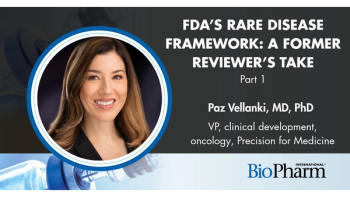
In the first part of a two-part interview, Paz Vellanki of Precision for Medicine explains what sponsors should bring to early FDA meetings and how manufacturing and assay readiness can delay rare disease trials.
Bristol Myers Squibb has exercised the option to in-license an immune-modulating drug candidate developed by Exscientia.
According to an Aug. 18, 2021 press release from artificial intelligence (AI)-driven pharmatech company Exscientia, Bristol Myers Squibb (BMS) has exercised the option to in-license an immune-modulating drug candidate that Exscientia developed.
The companies are already involved together in two active collaborative projects, focusing on multiple therapeutic areas. For this latest collaboration, the in-licensed candidate targets a critical immunological kinase that has proven difficult to target previously. In designing a novel candidate that overcame the targeting challenges associated with the immunological kinase, Exscientia employed its end-to-end platform to drive the discovery process.
“We are focused on using our patient-first AI technology to design precision engineered drugs against challenging drug product profiles. We are seeing great efficiency from our platform,” said Andrew Hopkins, CEO of Exscientia, in the press release. “This drug candidate molecule was just the 150th novel compound to be designed and tested and it was identified within 11 months of starting drug design. In partnership with Bristol Myers Squibb and its world-class research, clinical, and commercialization capabilities, we look forward to advancing this candidate into the next stage of development.”
“We are pleased to in-license our first drug candidate resulting from our strategic collaboration with Exscientia. AI and machine learning continue to play important roles in drug discovery and Exscientia has delivered a promising development candidate in the field of immunology. We look forward to our continued collaboration and further advancing this candidate for the potential benefit of patients with unmet medical need,” Rupert Vessey, president of Research & Early Development at BMS, added in the press release,
Source: